BOOK 2 · PART I · PLAY · STUDENT CHAPTER
What Were You Thinking?
Every robot at the table knows why it moved. The AI writes its reason down after every move. There is one player who never says why, gets tired, gets bored and plays worse as the night goes on. That player is you. This chapter is about knowing your own why, and about why the least reliable player at the table still has to be the one in charge.
Hand four
I sat down at the heads-up table against the AI agent: game 990544, $200 each. Three hands came and went. On hand four I looked down at two aces.
The AI had two kings. Neither of us could see the other's cards, of course. The board came 3♠ 3♣ 4♣ 7♠ 9♦, which helped neither of us. On the river I checked, and the AI bet. Then every chip went in. My aces beat its kings, and the game was over after four hands.
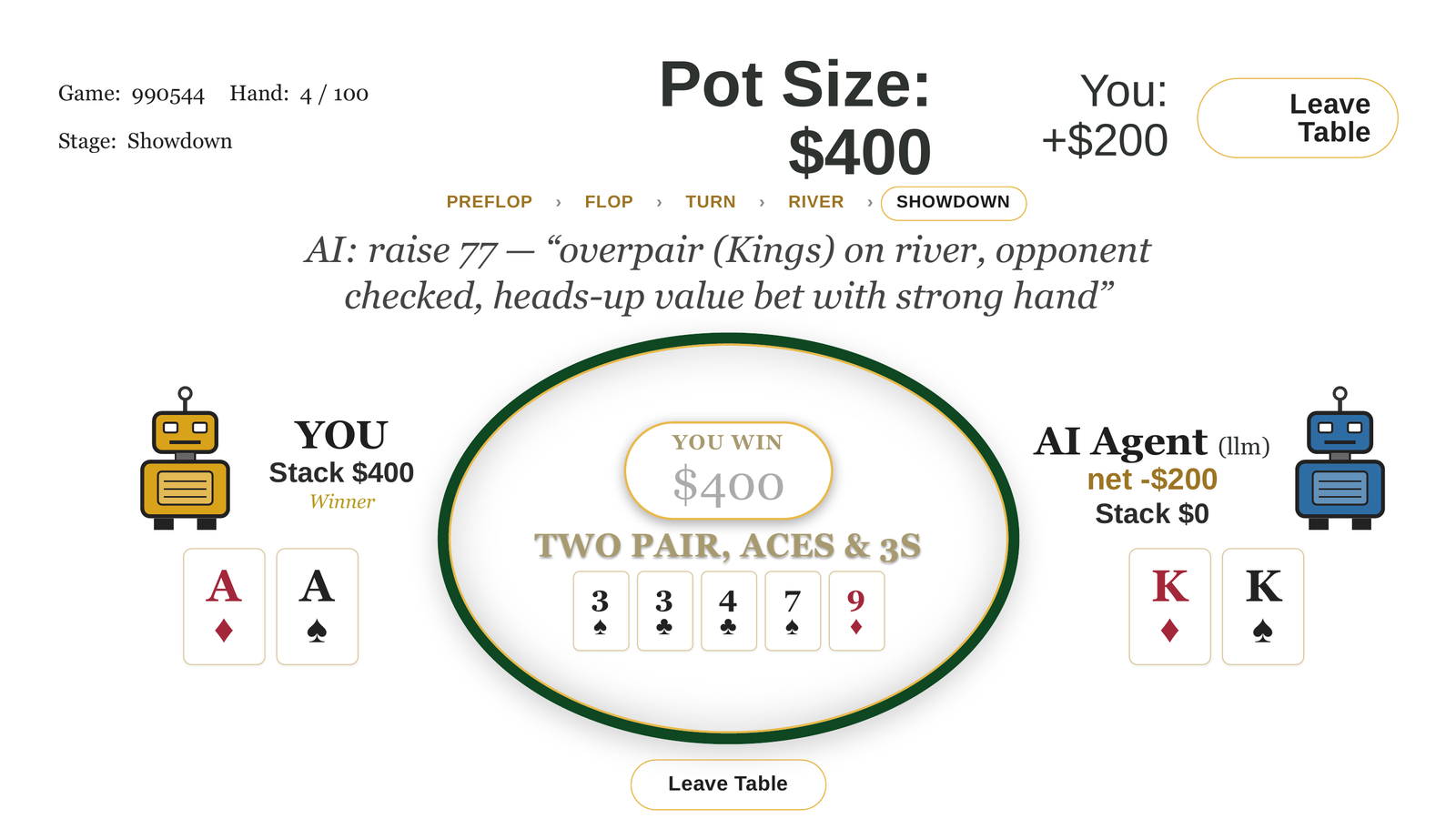
Game 990544, hand 4, at showdown. The AI's reason for its river bet is printed above the table. Mine isn't recorded anywhere.
Look at the line above the table. That's the AI's reason for its river bet, written down the moment it made it: "overpair (Kings) on river, opponent checked, heads-up value bet with strong hand." It's a sound reason. Kings are the second-best starting hand in Hold'em, and when the other player checks the river, betting a strong hand to get paid is exactly what good players do.
Now look for my reason for checking. It isn't there. The table never asked, so nothing records what I was thinking.
I did have a reason, and a good one. Jeff and I had played this bot enough to learn its habits. When I check, it reads that as weakness and bets. So with a strong hand, I check and let it put the chips in for me. That's a trap, and on hand four it worked exactly as planned.
The machine's reasoning went on the record; the human's best thinking lived only in my head. That gap is what this chapter is about.
So who played well? Both of us. Aces and kings are both in Sklansky's group 1, the strongest starting hands in his ranking, and both deserve to play for a big pot heads-up. Who won? That was the cards. Hold onto that difference; it's the most useful idea in this book.
The one player who never says why
Look around the table. The robots on the Sushi Menu play by rules you can read: their checkboxes are their reasons. The AI agent writes a short reason beside every move, and you can read it afterward in Game Review. Every seat at the table can tell you why it did what it did, except one.
You. You fold, call and raise, and nothing records what you were thinking. A week later you can't remember. Ten minutes later you remember being smarter than you were.
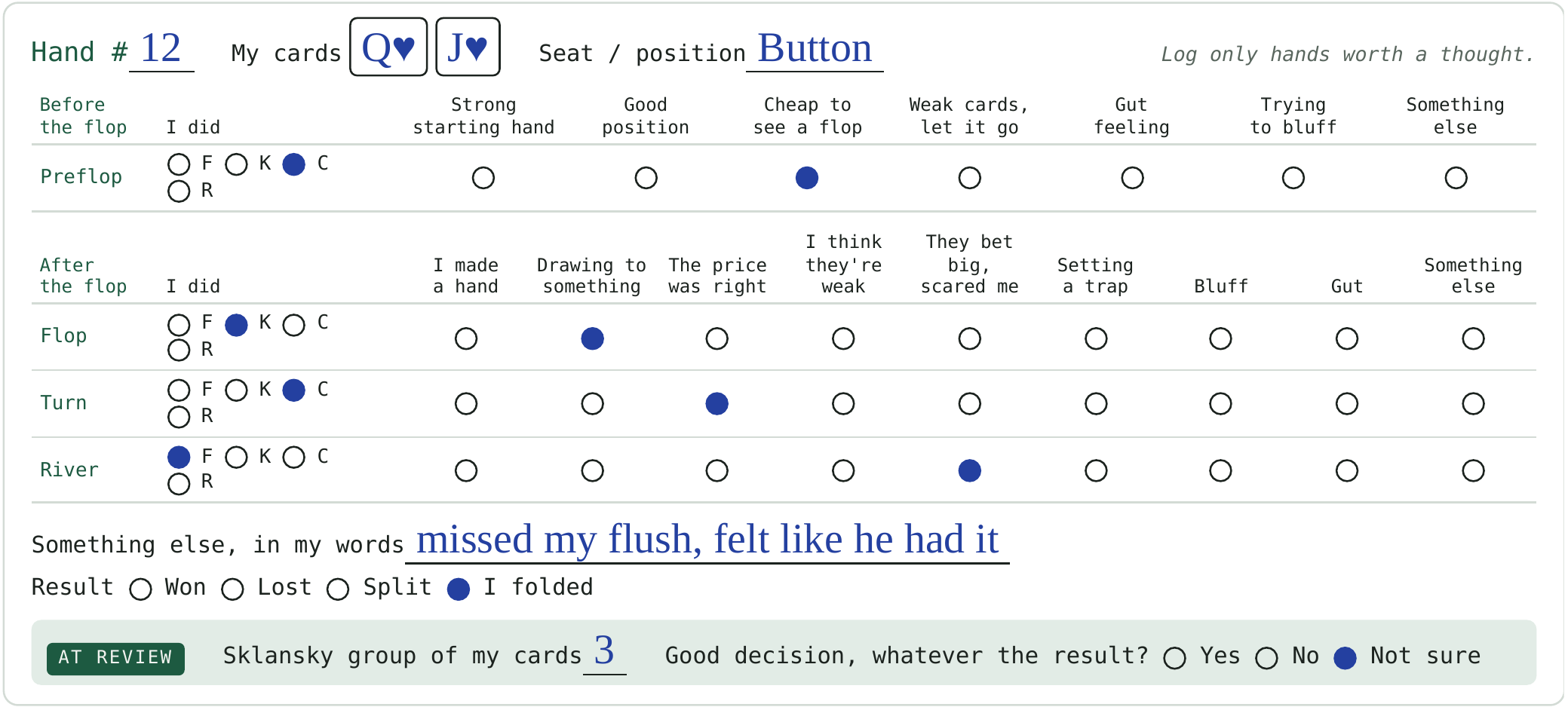
The hand journal fixes that. It's a printed sheet: What Were You Thinking? For each hand you write up, you fill one circle for what you did and one for why, in the same words the Sushi Menu uses. Two seconds a move.
| □ □ □ ■ | □ | □ | ■ | □ | □ | □ | □ |
| □ □ ■ □ | □ | ■ | □ | □ | □ | □ | □ | □ | □ | |
| □ □ □ ■ | □ | □ | ■ | □ | □ | □ | □ | □ | □ | |
| ■ □ □ □ | □ | □ | □ | □ | ■ | □ | □ | □ | □ |
One hand from the journal, filled in. Queen-jack of hearts on the button: called because it was cheap, checked a flush draw, called the turn at a good price, folded the river to a big bet. The full journal is three printable pages.
Look at the last line. The player isn't sure the river fold was right, and that's the honest answer. "Not sure" is exactly what Game Review is for: open the hand, see what the other player held, and decide whether being scared was a read or just nerves.
You don't have to write everything down
Most hands aren't decisions. Seven-two offsuit, the worst starting hand in poker, is a fold, and writing about it teaches nothing. So the journal has a tally line at the top for easy folds: one mark each, done.
Write up only the hands where you had to think. A call you weren't sure about. A raise you made because something felt right. A fold you regretted. Those are the hands where your reasons live.
The journal is an exercise, not a record. Its job is to bring focus and thought to what's going on at the table. Part of that is learning to spot the no-brainers fast, so your attention is free for the hands that need it:
- A pair to start. Two cards of the same rank in your hand, like 9♣ 9♦: an easy opening hand.
- Suited connectors. Two cards of one suit, next to each other in rank, like 8♥ 7♥. They can grow into a straight or a flush.
- A rainbow flop. Three board cards, three different suits. Nobody can have a flush draw yet.
- A counterfeited hand. The board takes your hand's value away. You hold 4♠ 4♥ and the board pairs twice, K-K-9-9: everyone now has two pair, kings and nines, and your fours are just a spare card.
Each one is a pattern you'll know at a glance after a few sessions. Fill the journal in as you play, quickly, between hands. The deeper look comes later, in Game Review.
How many things can you keep track of?
People can hold only a handful of things in mind at once. Poker is a fun place to find out how many, because the number of things compounds. Before the flop, you're weighing two cards and your seat. On the flop, add three board cards, how many players are left and what each one bet. By the river, there are five board cards, four rounds of betting, and whatever you remember about this player from an hour ago. The journal shows you where your attention ran out.
That pile of things has a name: context. Ace-king is one hand in the big blind with everyone folded, and a different hand facing a raise and a re-raise. The cards are the same. The context isn't.
Context is the skill underneath everything else in this book. To program a robot, rules-based or AI, you have to decide what context it gets and what it should do with it; that's Part II. To work with an AI coworker, most of the conversation is about context: what it knows, what it doesn't, and what you forgot to tell it. Twenty years ago I met an AI professor at the University of New Mexico who had written the book on AI. He had a line I've enjoyed ever since:
Context is why "Yes" is always the wrong answer to the question, "Do you know what time it is?"
An AI professor at the University of New Mexico
Why your reasons drift
Here's an honest confession. Jeff, a friend from high school who plays Las Vegas tournaments, once lasted about seven hours in a tournament and finished in the top 10%. I entered the same tournament and was out in the first 20%.
I enjoy the puzzle. I get bored sitting there, and then I play too much.
Kevin, Backroom Dialog 9
Poker players call that spewing: putting chips in for no good reason because you're bored, tired or annoyed. Its louder cousin is tilt, when a bad beat makes you angry and every decision after it gets worse. Even a hundred hands against the AI leaves me mentally spent after about an hour.
The robots don't do that. Two fast AI seats play a hundred hands in about ten minutes and are ready for the next hundred. Hand one thousand is played exactly like hand one. No boredom, no tilt, no bad mood carried over from the last hand.
That doesn't make the machine perfect. A rules robot makes the same mistake every single time: one of the house rules folds ace-king before the flop, every time it faces a bet. An AI can vary a little from run to run and can be confidently wrong. Steady isn't the same as right. But the machine's mistakes stay the same size all night. Yours grow as the night gets longer.
Your journal will show it. If your "Gut" and "Something else" marks pile up in the last twenty hands, that isn't new insight. That's you, tired.
Odd bedfellows
So the human is the least reliable player at the table. You'd think the lesson is "let the machine do it." It isn't.
The robots and AI seats in this project never once asked whether something was wrong. The AI seats in the backroom tournament played two thousand hands without complaint, and it took a person to read all 614 flags the system raised along the way. The robots never adapt; every move starts from nothing. And when we checked whether the Dealer itself had dealt fairly, the check happened because a person asked how it had done.
That's the partnership, and it's an odd one. The machine brings patience: it plays the ten-thousandth hand as carefully as the first. The person brings judgment: what's worth checking, what's wrong, what to try next. The project's rule for this is short: use people to find problems, machines to measure fixes.
And steady cuts both ways. A bot that plays hand one thousand exactly like hand one also has the same habits on hand one thousand, and people learn them. Jeff and I found two: it bets when you check to it, so you trap it with strong hands; and when it checks a lot, it's usually weak, so you bet the river and it folds. The bot never notices it's being read. It can't learn from losing. People adapt, and a bot that never changes is a bot that people eventually beat. That's the other reason the human stays in the loop: only people find the leaks.
To be the person in that loop, you have to be a reliable judge of your own thinking first. That's what the journal trains.
At the table
- Print the hand journal (three pages). Fill in your name, the date and which table you're playing.
Done when: page 1's top line is filled in. - Pick your opponents. On the Advanced Simulator, use the Sushi Menu or the house bots; or sit down at the heads-up AI table.
Done when: the first hand is dealt and you've written down the game number. - Play. Easy folds get one tally mark. For any hand that made you think, write its hand number and your cards, then fill one circle for what you did and one for why, for each street you played.
Done when: you've written up at least one hand. - Stop whenever you like. One hand is enough to learn something; a hundred is the most, not the goal.
Done when: you've quit and seen your results. - Open the game in Game Review. For each hand you wrote up, fill in the "At Review" strip: your cards' Sklansky group, and whether it was a good decision, whatever the result.
Done when: every written-up hand has a Yes, No or Not sure. - Turn to page 3. Count your whys, then write down the reasons no robot's checkbox could hold.
Done when: the "What no checkbox could say" box has at least one line in it.
Try it yourself first
Three hands from three different players. For each one, decide: good decision or not? Then check the answer key.
- Maya holds pocket kings and goes all-in before the flop. Her opponent has pocket aces. Maya loses everything. Her journal says: Strong starting hand.
- Theo holds seven-high and nothing else on the river. His opponent makes a huge bet. Theo calls and wins, because his opponent was bluffing with even less. His journal says: Gut.
- Sam played 60 hands. In the first 20, his journal shows one "Gut." In the last 20, it shows seven "Gut" and four "Something else," and he lost most of his chips in that stretch.
ANSWER KEY
Maya: a good decision that lost. Kings are a Sklansky group 1 hand. Heads-up, all-in with them before the flop is right almost every time. She ran into the one hand that beats her. Her reason was true and her play was sound.
Theo: probably a bad decision that won. A seven-high call on the river wins only when the other player is bluffing with even less, which is rare. "Gut" is honest, but it isn't a reason anyone could repeat. If Theo makes that call every time, he loses over time, no matter how this hand turned out. The useful question for Theo is what his gut noticed. If he can name it ("they bet big every time they missed"), that's a real read, and it belongs in "What no checkbox could say."
Sam: tired, not unlucky. His reasons changed as the night went on. The jump in "Gut" and "Something else" late in the session is the journal catching him spewing. The fix isn't a better rule. It's knowing when to stop, which the robots never need to know and humans always do.
Written by Kevin Swinson with Claudette, the pen name for Claude, the AI from Anthropic that helped build HoldemRobots.AI. The tournament figures come from the Backroom Dialogs (Dialogs 9 and 10) and the diversions record of October 29, 2026; Kevin's tournament story is from Dialog 9; the two habits Kevin and Jeff learned to exploit are Kevin's own account, and Book 1, Part 16 covers more. The hand journal is What Were You Thinking?, three printable pages. Hand four is game 990544 on the public heads-up table, from Kevin's screenshot.